

In an unusually bold satirical take in the wake of a drastic fuel price hike in Iran, Ali Zia, a prominent young state TV moderator, mocked the authorities’ hypocrisy when they talk about average Iranians’ high cost of living: “Our authorities…compar[e] our taxi fare with that of New York, the price of gasoline with that in London, the price of rent with that in Paris…but when it comes to wages, they make a comparison with Ethiopia.”
This strikes at the core of the socio-economic conditions driving the ongoing nationwide protests in Iran, after fuel prices almost tripled last week. According to the Tehran governor, 70% of provinces have experienced recent protests. Iran still has among the world’s cheapest fuel prices — only Venezuela’s and Sudan’s are lower. But the government’s rationale for the price hike — as a way to fight gasoline smuggling — doesn’t hold much water: Although the increased prices reduce the profit margin, large-scale smuggling (e.g. by entities associated with the Islamic Revolutionary Guard Corps, or IRGC) remains lucrative in part because gas prices in neighboring Iraq and Afghanistan are more than double Iran’s. Moreover, declining domestic fuel consumption will allow Tehran to export more to neighboring countries in return for much-needed hard currency.
At the same time, lower-income households have been experiencing accumulated economic pressures, hence the vocal response on Iranian streets. The “nocturnal onslaught,” as one journalist put it, of the price increase was merely the last straw. Half of Iranians are believed to live around the poverty line, youth unemployment and inflation are extremely high, and wages are low. Meanwhile, the past few years have seen rising food prices, and income inequality and corruption. Crucially, the rise in fuel prices will raise the cost of transportation and thus that of multiple goods — including food staples that form the main expenditure for poor households — making them even more unaffordable.
Against this backdrop, the government’s promise to balance this sudden measure by redistributing the revenue from the fuel price increase to 18 million needy households (about 60 million people) is an implicit admission of the vast extent of Iranians’ socio-economic misery. Under former President Mahmoud Ahmadinejad, cash payouts were instrumental in reducing the poverty rate. President Hassan Rouhani, for his part, claimed that the lower classes would actually benefit from the tax-and-redistribute scheme; but that exact segment of society actually immediately took to the streets.
Part of the reason is because the actual implementation and impact of the compensation plan remain very uncertain. It is totally unclear who those 18 million households are, and the lack of transparency allows the regime to either embezzle payments or pinpoint them to highly restive locations. The fact that protests erupted despite those promises of compensation signals deep popular distrust toward regime promises. And according to calculations for an average medium-sized car (with a 55-liter tank), the cash compensation for one person (set at 55,000 Toman, or about $4.44) would not even make up for the rise in fuel prices at a 1,500-Toman rate per liter.
TIMING OF THE FUEL PRICE HIKE
The shock price adjustment was decided on by the Supreme Council of Economic Coordination, comprised of the heads of the three branches of government, representing all three major élite factions: President Rouhani from the centrist faction supported by the reformists, the Speaker of the Parliament Ali Larijani from the conservative camp, and Judiciary Chief Ebrahim Raisi from the ultra-conservatives. Supreme Leader Ali Khamenei, without whose approval the snap decision would have been unthinkable, halfheartedly disassociated himself from it by claiming he is “not an expert” in economic issues, while expressing support for the government’s decision. Labeling the protesters “hooligans,” he called for a crackdown, which has been seen as an unprecedented open call for the use of violence. Notably, parliament had opposed the price increase, arguing that it would mean more pressure on the poor and could lead to “uncontrollable” protests. But its legislative role as well as its warnings were ignored.
The sudden and utterly mismanaged implementation of the fuel price hike, which failed to simultaneously accompany the subsidy removal with compensation for the poor, begs one key question: Why now? The authorities could have waited for the February parliamentary elections to pass before taking such drastic measures, for instance. The very timing suggests that the state acted out of a sense of duress and urgency given an extremely strained budget, which would have jeopardized its ability to pay its employees, including its security organs, over the next few months. Oil income has crumbled and semi-state institutions — the economic empires associated with the “religious foundations,” the IRGC, and the supreme leader — have continued to resist accountability and taxation. Therefore, the state elites resorted to delving into the people’s already pretty empty pockets, expecting an annual income of $2.55 billion from the fuel price hike (or $212.5 million per month). This drew the ire of the very same people who have witnessed the ruling class’ corruption and nepotism.
Moreover, at this particular juncture the Islamic Republic not only faces U.S. “maximum pressure,” but also a serious threat to its regional standing and influence: The depth of anti-Tehran sentiments in ongoing protests in Lebanon and especially Iraq constitute a serious threat to its “strategic depth” – a phrase used by the Islamic Republic to justify its presence in those countries as a way to maintain its security. These protests are consuming much of its attention and draining its financial resources even further — a key reason that demonstrators are again calling for the Islamic Republic’s disengagement from the region to focus on problems at home.
PARALLELS AND DIFFERENCES WITH THE 2017-18 UPHEAVAL
This new wave of protests and their slogans are reminiscent of the last major uprising that shook the Islamic Republic at the turn of the year 2018, before it died down following state suppression and the absence of middle-class involvement. In other words, the current protests must be seen as a continuation of the 2017-18 uprising, whose combined socio-economic and political grievances and drivers have remained unaddressed. Now as then, the protests have been sparked by economic grievances, yet they immediately turned into anti-regime demonstrations targeting the legitimacy of all wings of the regime — the so-called moderates as well as hardliners. They also spread to all corners of the country. Another parallel is the moderate or reformist political faction’s opposition to the protests, as they continue to benefit from the same system they have claimed to be willing to reform.
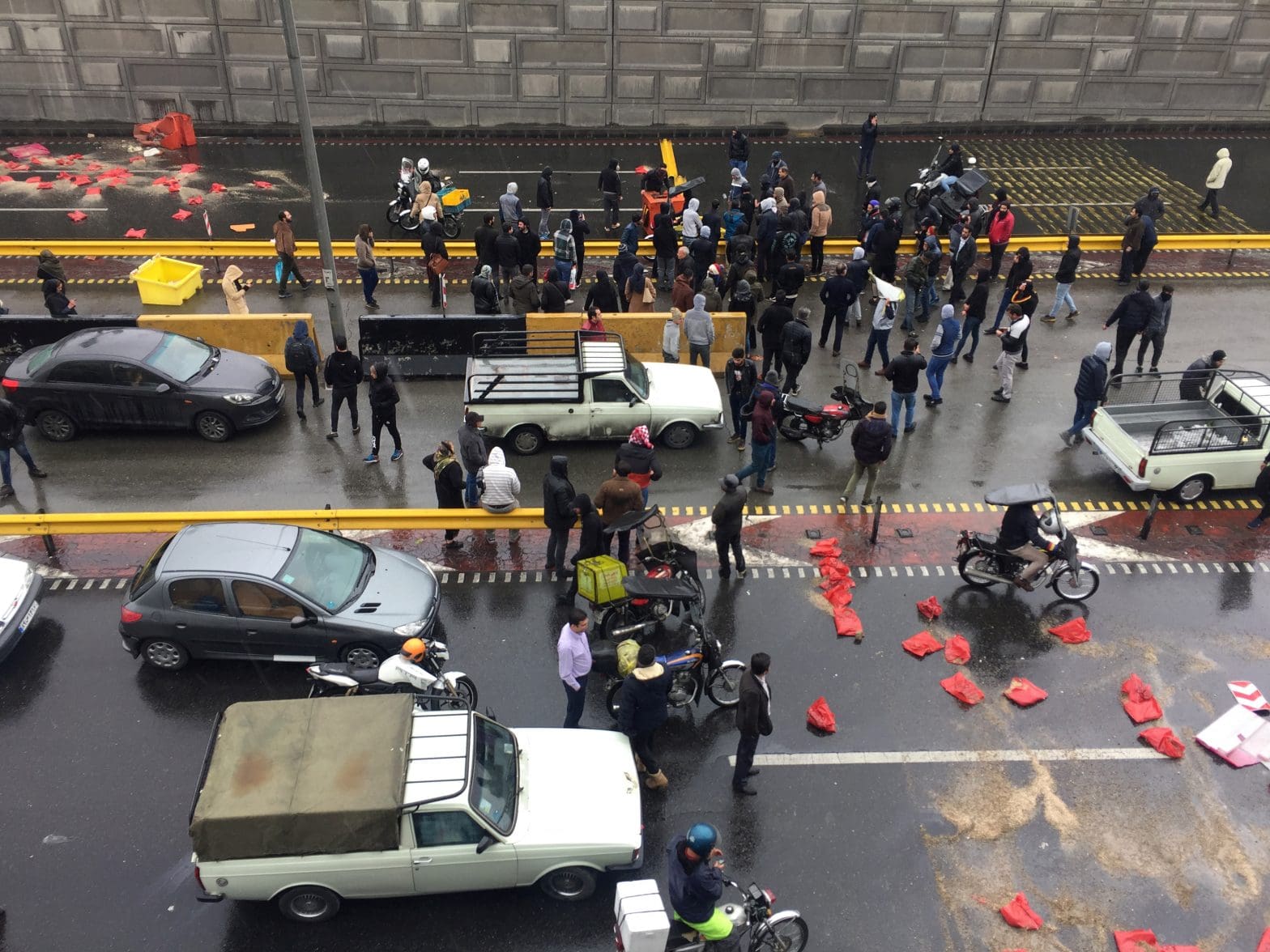
A key difference is scale: Even judging from the low estimates provided by the state, the number of protesters has doubled from 42,000 (according to the Interior Ministry) during the 2017-18 protests to 87,000 (according to an unnamed Iranian intelligence organization) this past weekend. Crucially, the capital of Tehran has seen more protests than back then, with a large number of major roads blocked by protesters.
Also, compared to almost two years ago, both people’s and the regime’s resolve has become more ferocious. Protesters have become more fearless, facing the forces of repression more adamantly and expressing their rage more openly — from burning down images of Khamenei and the statue of the founder of the Islamic Republic Ayatollah Khomeini to attacking sites affiliated with the police, the Basij (the paramilitary force) and Friday prayer imams, as well as banks. These are all symbols of the regime’s social, political, and economic oppression, which have been thorns in the flesh of young Iranians’ daily lives. The acts of vandalism that took place beyond that are mainly an expression of the immense pressure people have been facing, which has now exploded. Despite these acts, the protests have been largely peaceful, while authorities have green-lighted a brutal crackdown. Only a day after protests broke out, the regime imposed an unprecedented total internet blackout, hiding the situation from national and international scrutiny. That the internet is still shut down only signals that despite the heavy use of violence, the security forces haven’t been able to successfully squash the unrest. Also, within the ranks of the army, the police, and even the IRGC, many share those collective grievances. If protests continue, there might be chances of them sympathizing with or even joining the demonstrators. Hence the urgency and severity of state suppression.
A reason for the crackdown’s complication lies, in contrast to the 2017-18 upheaval, in the dispersed nature of the protests — with people gathering in multiple points across their cities —, making it harder to effectively suppress them, even though the state has deployed hundreds of thousands of security forces. In addition, there are indications that this time around protests have been spreading to more segments of society that have entered into strike to join them, like in the case of the Bazaar and of some universities.