
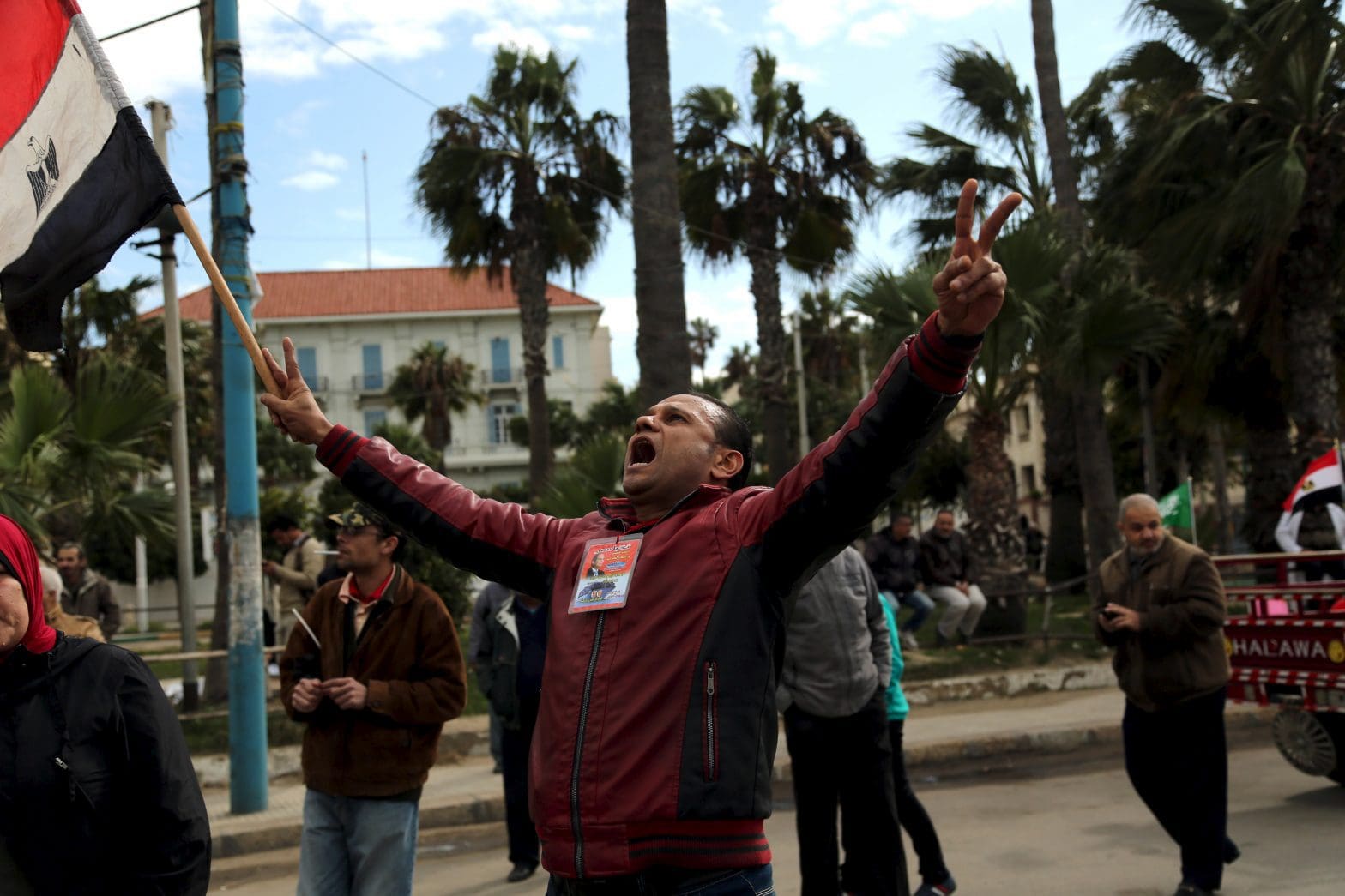

Furthermore, established political actors, exemplified by the Islamists or the existing regimes, continuously co-opt or sideline Arab youth. In the Tunisian National Constitutional Assembly (NCA), which was tasked with drafting the county’s first constitution after the revolution, only 4 percent of its members were under 30, while the vast majority (76 percent) were over 50. In Morocco, the cooperation between the king and the PJD had sidelined the 20th of February youth movement, which had lead the protests in 2011. In Egypt, youth politicians close to the regime and funded by its allies are encouraged to participate in the political process, while thousands of Egyptian youth— including many at the forefront of the revolution—remain in jail. In a report last year, Amnesty International said that Egypt’s 2011 “Generation Protest” has become 2015’s “Generation Jail.”
So far, in all elections held in North Africa since the Arab uprisings, the main contenders have either been the Islamists or elements of the ancien régime. In Morocco, the rivalry is between the PJD and the palace-backed Authenticity and Modernity Party (PAM). The competitors in Tunisia include Ennahda and Nida Tunis, a party which includes many Ben Ali- and Bourgiba-era politicians. In Egypt, the historical rivalry continues between the military and the Muslim Brotherhood, but at a diminished level after the latter has had its ranks decimated through jail, exile, or death. Irrelevancy infected many of the parties formed soon after the uprisings.
The lesson for the youth: protests need to be followed by building and/or joining sustainable political organizational structures which capitalize on street movement. The chant “eesh, hurriya, a’dala ijtima‘iya,” (bread, freedom and social justice) remains as a potent and admirable rallying call, but it needs a policy platform to elicit popular support and enact meaningful policy changes. If a new political option does not crystalize, then the Arab uprisings will remain forever stuck between the generals and the sheikhs.
THE REGIMES
Hyper-nationalist discourse can only take regimes so far. In Egypt, youth unemployment coupled with high inflation, a weakening currency, and dwindling foreign currency reserves can potentially incite further protests. The current protests against unemployment in Tunisia provide an early indication of more to come there and across North Africa, should the regimes fail to take youth unemployment seriously. The Tunisian protests show that even with a relatively successfully political transition, it means nothing if not matched by an equally successful economic transition. Even resource-rich Algeria is exposed: demographic pressures, paired with rising unemployment and lower oil prices, can potentially impact the stability in the country.
Street protests can also have security consequences, with potential radicalization of the youth. Thus, it comes as no surprise that unemployment-plagued Tunisia now provides the most ISIS fighters per capita in the world. Several recent studies continue to highlight the correlation between economic marginalization and terrorism. In Egypt, this problem is compounded further: Politically disenfranchised youth, lacking in economic opportunity, provide the perfect fodder for the ISIS-inspired insurgency in the Sinai Peninsula.
The lesson for the regimes: the growth and stability of North Africa will hinge on the youth of the region. Arab millennials—whose numbers continue to increase exponentially—find themselves in an environment very different from previous generations: more connected to the world than ever before, as well as more educated and aspirational. They have lived through and participated in the uprisings, and understand that political outcomes are no longer pre-ordained. Regimes in the region must ensure that youth are fully integrated into economic and political structures, so they don’t become a longstanding source of instability.