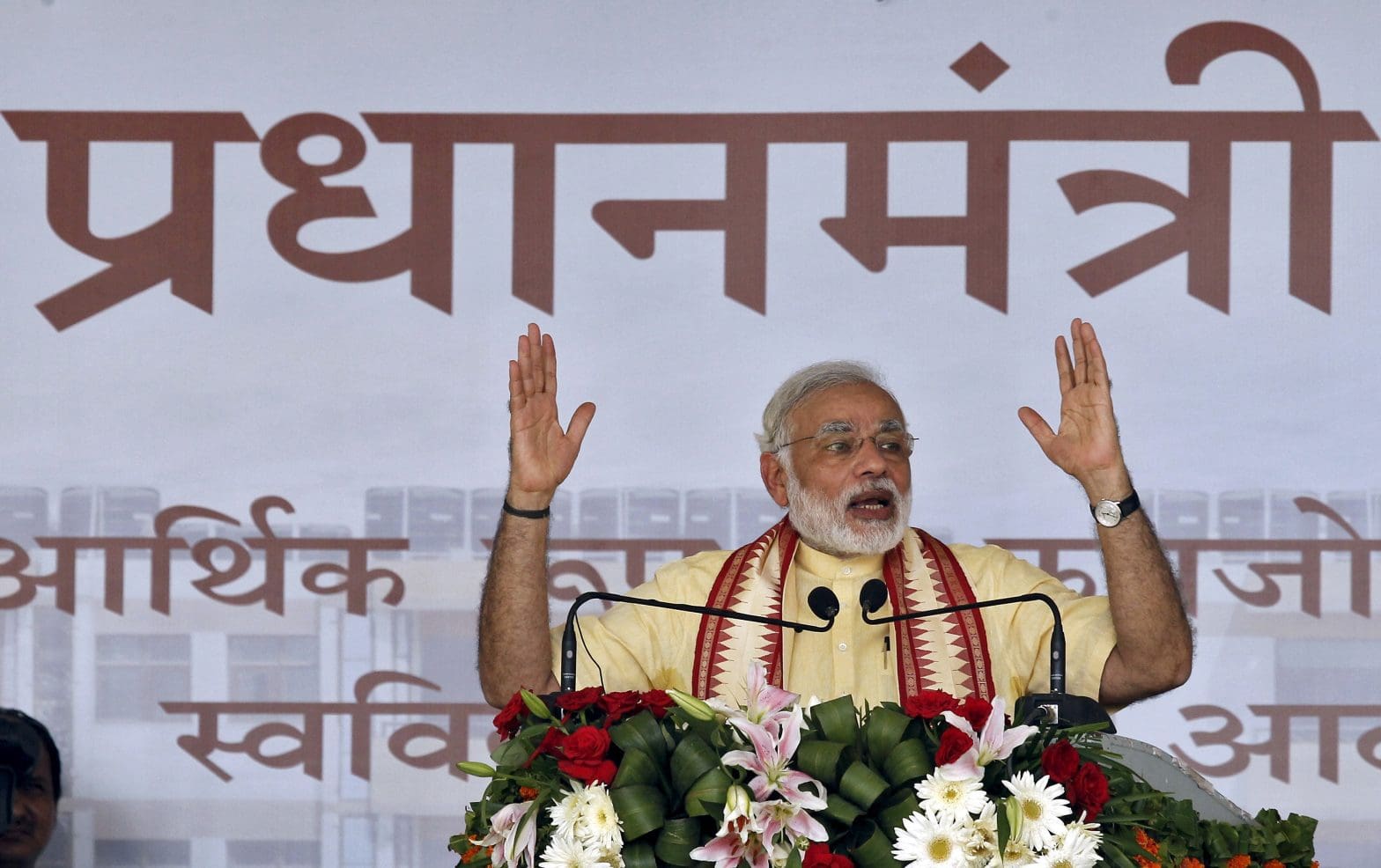
The August 2015 visit of Prime Minister Narendra Modi to the United Arab Emirates marked the first visit in 34 years of an Indian leader to the UAE and Modi’s first official trip anywhere in the Middle East. There has been much debate over the success and relevance of the visit. What is clear, however, is that the prime minister has grasped the Gulf’s increasing strategic importance for India.
India has a long history of relations with the Middle East, more than any of today’s existing or emerging great powers. Emperor Ashoka had ties with ancient Egypt’s Ptolemy II. Arab traders settled on India’s eastern coast. One of the earliest mosques in the world was built in Kerala in 629AD. Mughal rule then saw the entry of Islam to India on a mass scale. During British colonialism, the Raj administered autonomous Gulf Arab states from India.
This legacy is far better remembered amongst Gulf states than it is in Delhi. Gulf policymakers exhibit a comfort and familiarity toward India that was not always shared by Indian leaders, who tend to be hamstrung by sensitivities over domestic Hindu-Muslim relations. For this reason, as well as geopolitical factors like the India-Pakistan rivalry and Cold War divisions, India-Gulf relations tended to emphasize commercial interests in recent years.
Modi’s visit of course touched on these. The UAE agreed to invest $75 billion to support India’s massive infrastructure needs. Infrastructure investment is key to India’s rise to great power status and always ranks high on Modi’s agenda for international visits. The Gulf states are particularly useful given their large foreign currency reserves. The UAE ranks as one of India’s top trading partners, and the two countries agreed to aim for a 60 percent increase in trade in the next five years.
As important as they are, economic interests can no longer be the primary focus of the bilateral relationship. And Modi, whose political resume and fractious relations with India’s Muslim community would seem to make him the least likely candidate to strengthen Middle East ties, may be the one to turn around decades of strategic neglect.
THE GULF STATES’ STRATEGIC RELEVANCE FOR INDIA
Several factors make the Middle East, particularly the Gulf, more strategically important for India.
First, New Delhi’s existing economic interests have gained a strategic dimension with a growing reliance on Gulf oil and gas. The joint statement signed at the conclusion of Modi’s visit heralds the promise of a strategic partnership in energy, including in the development of petroleum reserves, upstream and downstream investments, and collaboration in third countries.
Secondly, the central geopolitical shift in the region is the diminishing of US interest and influence, making for a more multipolar Middle East. China will be the greatest beneficiary of this. New Delhi, wary about the implications for its energy security, is compelled to act.
Furthermore, the fluid security situation in the broader Middle East provides new opportunities for an ambitious India. The Gulf states are looking to diversify their security guarantors and may seek to maintain leverage by working with multiple strategic partners. It is unlikely that China will be able or interested in replacing Washington in the medium term.
The Gulf states sit at the western rim of the Indian Ocean, Dehli’s perceived sphere of future strategic influence. More broadly, problems of increasing state fragility and growing threats from terrorist groups in the Middle East jeopardize India’s energy interests and migrant workers.
For this reason, Modi’s visit elevated the UAE relationship to a “comprehensive strategic partnership,” including the establishment of a “Strategic Security Dialogue” and engagement between their respective national security advisors and national security councils. There will be regular exercises and training of naval, air, land and special forces, and in coastal defense. This reflects a broader agenda in the Gulf as seen in recent days with the high-profile visit to Qatar of Indian naval ships.
The UAE will participate in India’s 2016 International Fleet Review, and cooperate in defense manufacturing in India. The two countries will also collaborate on cyber security, intelligence, and even space exploration. At the global level, the Statement called for expeditious reform of the UN, with the UAE supporting India’s bid for UN Security Council permanent membership.