

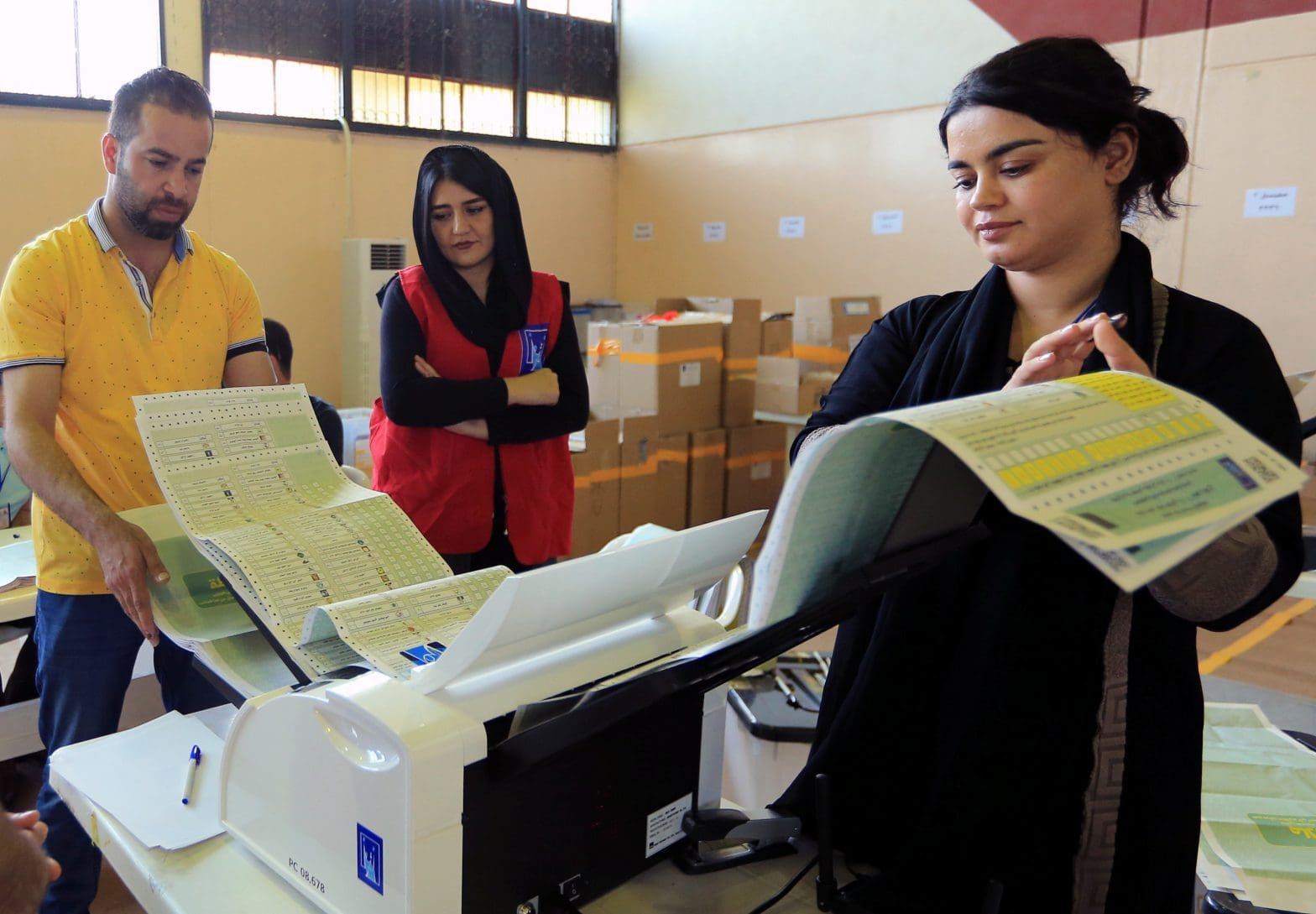
Iraq’s parliamentary elections on Saturday were supposed to herald a new chapter for the country, one where it finally moves forward to remedy endemic corruption, violent instability, and social and political polarization. The first election since the defeat of ISIS and its so-called Caliphate last December, the election was historic in many respects and saw 7,000 candidates vying for just 329 seats.
Elections in a country that has faced the violence and turmoil that Iraq has should not be understated. That said, Iraq will not turn a new chapter, at least not in the way the United States expected: The elections produced a winner in the historically anti-U.S. Sadrist movement and a severely weakened Prime Minister Haidar al-Abadi, billed in some Washington quarters as “America’s man in Baghdad.” Moreover, the election helped strengthen the Popular Mobilization Force (led by Iraq’s powerful, Iran-aligned militia groups), which will likely embolden its demands for an American withdrawal from Iraq.
BAD CIRCUMSTANCES
Despite the media frenzy and the high hopes surrounding his prospects, al-Abadi failed to inspire a new beginning—alleviating ethnic and religious tensions and finally forging the national consensus Iraq so desperately needs. At the time of writing, al-Abadi was hoping, at best, to come in third place. This was also, arguably, Iraq’s worst election to date as a result of the 44.5 percent voter turnout (the lowest since 2003), and that may have effectively shattered the democratic legitimacy Iraq’s political class has enjoyed since 2003. Voter turnout is particularly important because in the absence of the rule of law—and in the face of corrupted, weak institutions—Iraq’s electoral process is critical for citizen accountability. Voting is among the few functions of accountability the public still has at its disposal.
None of this should come as a surprise. Elections can provide an opportunity to establish a clean slate between communities, between competing members of the political class, and between citizen and state. But they are not a panacea: Iraq is still engulfed in endemic corruption, ethno-sectarian divisions, and a plethora of disparate militia groups that have now enhanced their hold on the country following Saturday’s elections. Its institutions are weak or dysfunctional. These are not the makings of a country emerging from the ashes of war stronger and more unified.
Hopes that al-Abadi could steer Iraq forward toward that outcome, simply off the back of the military campaign against ISIS, were misplaced and counterintuitive. The war on ISIS was Iraq’s bloodiest and most brutal conflict since the Iran-Iraq war in the 1980s—but unlike that war, this was a conflict that unfolded against the backdrop of more than a decade of ethno-sectarian divisions and conflict. Moreover, it was an intrastate conflict between Iraqis, since ISIS was by and large a local terrorist organization, and that diminished the rally around the flag effect that wars generally provide.
Other conflicts have played out over the past three years, in the shadow of the war on ISIS. That includes clashes between Erbil and Baghdad (just months before the elections, at al-Abadi’s bidding and with U.S. acquiescence) and Shiite militia sectarian atrocities against Arab Sunnis. Iraq’s Arab Sunnis were thought to have bought into the Shiite-dominated political order, but Saturday’s low turnout and al-Abadi’s inability to become the cross-sectarian prime minister that outside narratives suggested shows that Sunnis were, in fact, simply too bloodied and fatigued. In other words, wartime conditions do not accurately reflect the state of inter-community relations, much less provide an environment conducive to reconciliation.