
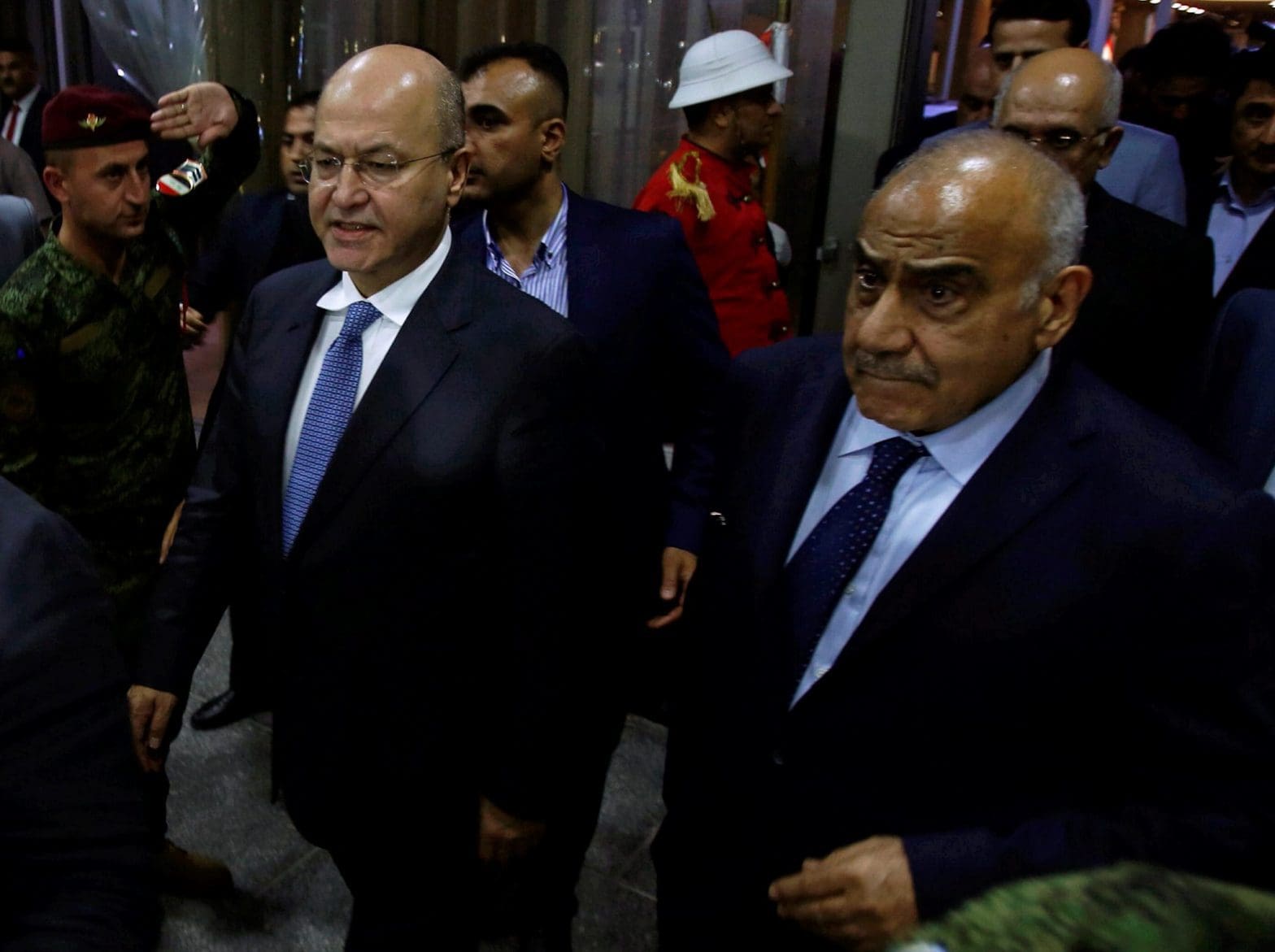
Iraq now has a new government in place, six months after holding elections against a backdrop of a long period of political instability and social unrest. With the new leadership of Prime Minister Adel Abdel Mahdi and President Barham Salih—both widely touted as reformist, progressive, and Western-leaning—there are high hopes that the country will turn a new chapter after three bloody and arduous years of combatting the so-called Islamic State. Iraq has a multitude of problems, but with this new coalition government, which includes Iraq’s main communities and factions (Mahdi is a Shia politician, Salih a Kurdish one), there could be an important opportunity to seize the momentum and move the country forward.
NOT OUT OF THE WOODS
There are still major challenges to preventing an ISIS comeback and addressing sectarian divisions, the grievances of Arab Sunnis, and weak institutions. Iraq continues to suffer from dilapidated infrastructure, endemic corruption, vulnerability to outside influence, a bloated public sector, and a rapidly growing population. In other words, reforming Iraq will take years, if not decades.
The new government takes shape amid widespread and vociferous public demands for reform. Iraq’s most recent prime minister, Haidar al-Abadi, failed to win another term amid public discontent and opposition from the powerful Shiite clergy, which stood against him because of his abysmal record in office. With Abadi out, it is the first time in 13 years that Iraq is no longer led by the Islamic Dawa Party, which in many ways failed to satisfy public expectations. It was under then-Prime Minister Nouri al-Maliki’s sectarian watch that Mosul fell to ISIS in June 2014.
Prime Minister Mahdi, a compromise candidate, will have his work cut out for him in the face of a dysfunctional political system and institutional paralysis—problems that may take generations to rectify. He inherits a more than decade-old ethno-sectarian power-sharing structure. Furthermore, both Mahdi and Salih face pressures and constraints from their own respective communities: Mahdi, a longstanding member of the Shiite ruling class has still to complete his cabinet, amid pressure from rival powerful Shiite factions who may torpedo his efforts to govern or advance reforms; Salih, a longstanding senior member of the Patriotic Union of Kurdistan (PUK) and former Kurdistan Regional Government (KRG) prime minister was controversially appointed against the will of the Kurdistan Democratic Party (KDP), Kurdistan’s most powerful party.