
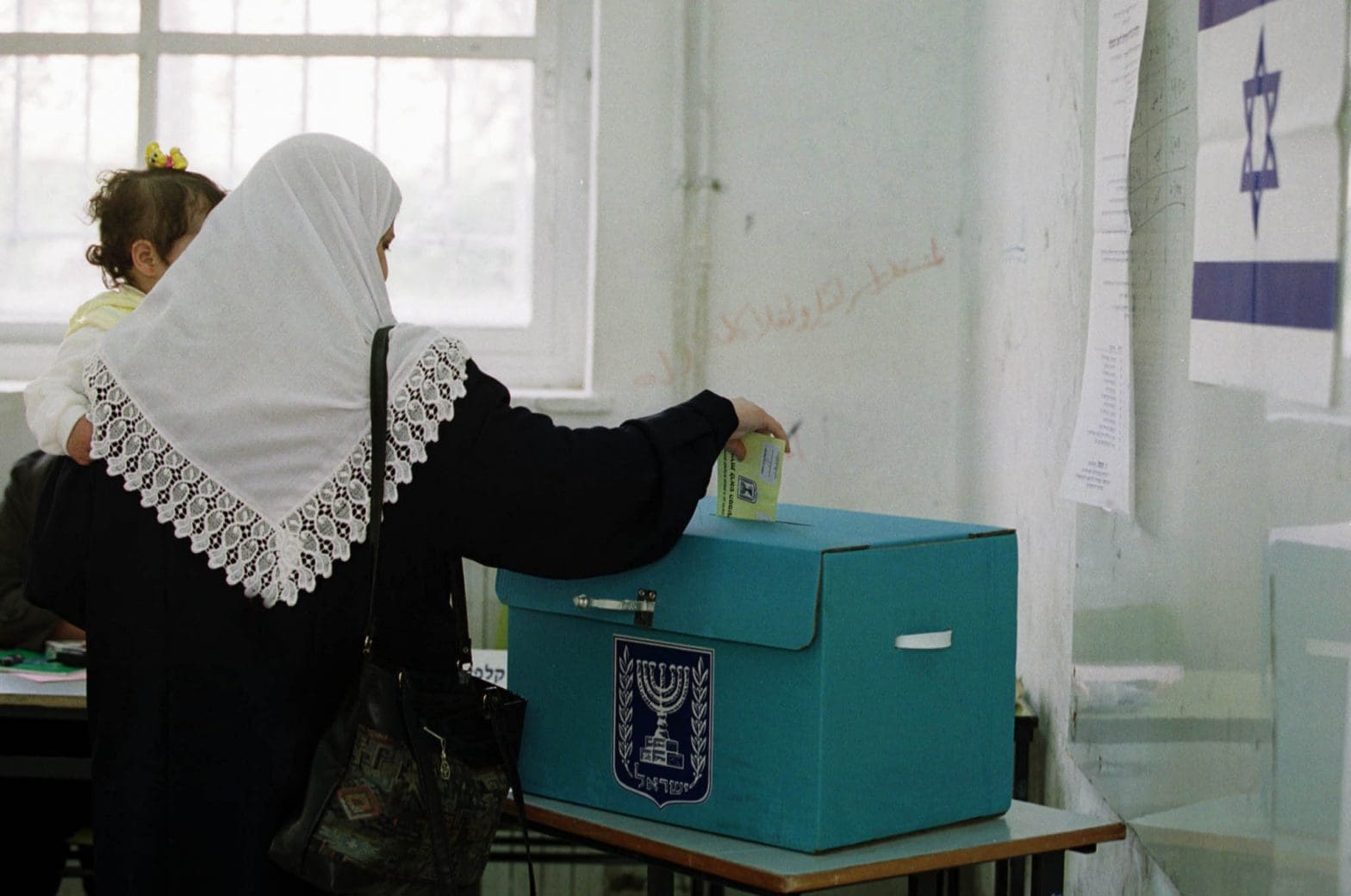
During elections on April 9, Arab political parties in Israel narrowly escaped a catastrophic defeat at the polls, as historically low voter turnout threatened to reduce—and possibly even eliminate—their political representation in the Knesset. A late surge in the final hours of voting, which brought the percentage of Arab voters to around 49 percent, ultimately saved the day, with one Arab party coalition, Balad-Ra’am, barely meeting the 3.25-percent threshold for entry by .05 percentage points and securing four seats in the parliamentary body. Together with the other Arab party coalition, made up of Hadash and Ta’al, they combined for 10 seats, down from 13 in the previous Knesset.
While there was some indication ahead of election day that calls in the Palestinian-Arab community in Israel to boycott the vote might impact turnout, the reality that turnout could be extremely low only began to set in on the day of the election. In the city of Nazareth, the largest Palestinian-Arab city in Israel and the political capital of the community, it was hardly noticeable that an election was being held at all. Typical expressions of voter enthusiasm and party loyalty were subdued. At one polling station I entered in the middle of the afternoon, there was not a single voter in the ballot room. Outside the building, political operatives for the major parties frantically worked their phones trying to get people to show up.
The tone of leading Arab politicians changed starkly over the course of the day. In the morning, tweets from political leaders were upbeat and optimistic. But by early evening the messaging had turned to panic. Ta’al party leader Ahmad Tibi said the voting numbers constituted “a real danger.” Mtanes Shihadeh, the head of the nationalist Balad party—which was aligned with the Islamic Movement’s Ra’am party—called the low turnout potential “political suicide.” And Ayman Odeh, the leader of the largest party, Hadash, tweeted “our nightmare” scenario—losing representation in the Knesset—suddenly seemed like a realistic option.
So what happened? Why did a relatively large turnout among Arab voters in 2015, nearly 64 percent, suddenly plunge by 15 points?
Part of this can be chalked up to a simple return to trend. Arab voting numbers had been sliding downward for years as disillusionment with the electoral process and growing alienation from Israeli society as a whole generated increasing apathy among the Arab voting public. Some attrition can also be attributed to voter suppression. The decision to hold national and local elections on different dates is seen as a strategy to suppress the Palestinian-Arab vote in national elections, for instance, since their turnout for local elections—which are more directly linked to their daily lives—is higher. In 2015, however, the four main Arab parties united to form the Joint List. This occurred after some right-wing lawmakers, including Avigdor Lieberman, successfully raised the electoral threshold in a conspicuous attempt to take advantage of Arab political fragmentation and keep their parties out of the Knesset. The unification was a historic moment, and it energized the public. People felt that their leaders had made an important step in transcending their differences, and that it might finally allow them to wield real influence. This didn’t exactly pan out. And when Arab members of Knesset not only failed to capitalize on the opportunity but even failed to keep the coalition together amid petty infighting ahead of the next elections, voters were bitterly disappointed.
But this doesn’t fully explain the widespread calls this time around to boycott the election. While some have characterized the call to boycott as a movement, this description is also not apt. A movement suggests a recognizable degree of organization and an underlying ideology. Yet decisions to boycott the 2019 election were largely made by individuals, responding to a host of (arguably connected) motivations and frustrations.
One of them is a longstanding belief that participating in national elections grants legitimacy to Israeli democracy, which many feel is inherently undemocratic to its non-Jewish citizens. This point of view has caused some groups within the community, namely the Sons of the Village movement and the Northern Branch of the Islamic Movement, to boycott parliamentary elections, instead focusing on local elections and community development. One prominent professor, As’ad Ghanim, called on Palestinian-Arab Knesset members to resign.
This perspective has been steadily gaining traction over the past decade as Israel’s increasingly right-wing governments have passed numerous laws aimed at discriminating against and disenfranchising the Palestinian-Arab citizenry. The most important of these was the Nation State Law, passed last year, which defines Israel’s constitutional identity as exclusively Jewish, without any mention of democracy, equality, or non-Jewish citizens. Indeed, the law explicitly says that self-determination in the state of Israel belongs to Jews alone, thereby excluding Arab citizens from Israel’s determinative self.
Connected to this is the belief that Arab politicians are not able to influence policy, whether they have five seats or 20. Part of this can be explained by the fact that Arab parties have never been included in an Israeli governing coalition, limiting the possibility of such influence. Indeed, during the recent election campaign the main challenger to Benjamin Netanyahu’s Likud party, the Blue and White coalition led by Benny Gantz, explicitly said it would not include an Arab party in its coalition under any circumstances. The very perception of being open to such a possibility is seen as politically damaging in Israeli politics.