
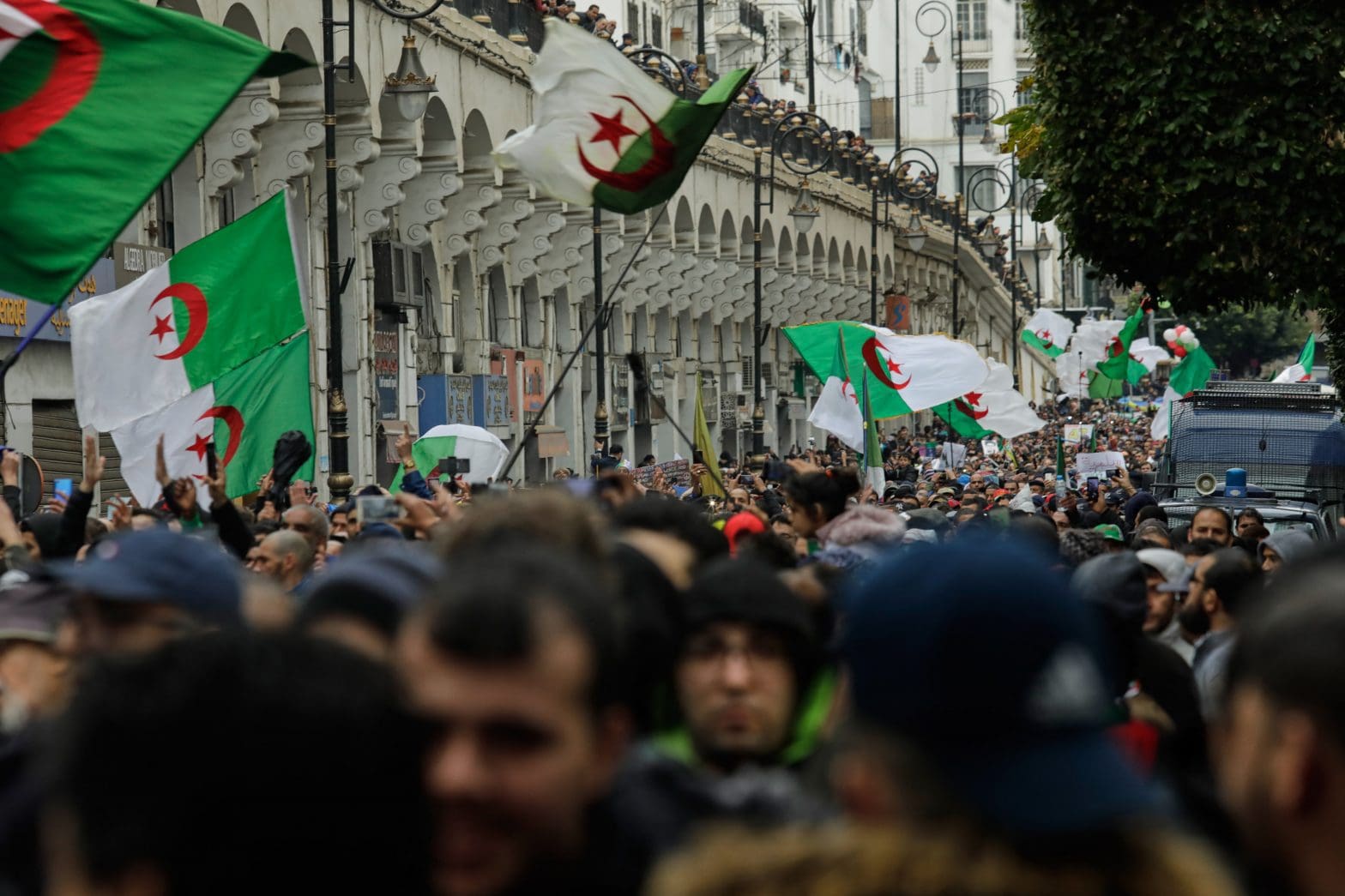
Algeria’s political crisis, which began when President Abdelaziz Bouteflika’s cronies announced on February 10, 2019 that he would run for a fifth term in office, has entered its 48th week. Millions of Algerians still march throughout the country every Friday to demand the dismantlement of the regime and the establishment of a genuine civilian democratic system, a movement that began on February 22, 2019. While the military forcibly removed Bouteflika on April 2, the peaceful protest movement — hirak — is not content with the half-measures or cosmetic reforms that the authorities offer. Instead, the government must address the demands that the hirak has put forth and initiate genuine change, rather than use subterfuges to maintain the present system.
HOW WE GOT HERE
The last 20 years of Bouteflika’s authoritarian, neopatrimonial, and corrupt rule — and the nature of the political system in place since independence in 1962 — have resulted in a real rupture of the social contract. Rulers have lost their legitimacy and the Algerian people resist being ruled under the old system.
Faced with a strenuous protest movement last year, the Bouteflika government initiated a roadmap before his April 2 ouster. The powerful vice-minister and head of the chiefs of staff, Ahmed Gaïd Salah (AGS), sought to implement that plan. His objective was to appoint a president loyal to him to provide a civilian façade for the military to maintain the same system. While the hirak succeeded in forcing the regime to cancel the two planned elections in April and July, AGS was able to impose a new date, December 12, without consideration for the wish of the people. Millions of Algerians at home and abroad objected to the December 12 election, and voter participation for that election was the lowest in Algeria’s history. (An official announcement claimed that 41% of eligible voters participated, but the best estimates ranged between 10% and 15%.) As the German newspaper Die Zeit put it, the Algerian regime should receive the Nobel Prize for electoral fraud. Former prime minister Abdelmadjid Tebboune (one of the five candidates, all part of the old regime) allegedly won 58% of the votes, and is now president. Tebboune was AGS’choice; the race between 5 candidates was mere diversion.
The election did little to ease the protesters’ demands. Quite the contrary: A march a few days ago, on January 10, 2020, demonstrated that the hirak — which has remained remarkably peaceful — has not lost momentum. Protesters are not ready to abandon their essential demands. A week before the march, the government freed 76 detainees, imprisoned under AGS’s iron-fist authority before his sudden death on December 23. The same day the prisoners were released, a new government headed by Prime Minister Abdelaziz Djerad was formed.