

Moroccan foreign policy has garnered significant attention in recent months amidst heightened tensions with the European Union, talks of further rapprochement with Israel, and stronger stances vis-à-vis its involvement in the Libyan peace processand its claim over the disputed territory of Western Sahara. Some argue that U.S. recognition of Morocco’s sovereignty over the latter has emboldened its decisionmakers, while others describe Rabat’s recent redirections as “aggressive.” What, in fact, is happening with the kingdom’s foreign policy?
As Morocco’s relationships with its traditional partners in Europe and with the Gulf monarchies became occasionally strained over the last decade, its decisionmakers sought to strengthen the kingdom’s position regionally and internationally through three strategies aiming to promote its diplomatic, political, security, and economic interests: diversifying international partnerships to avoid over-relying on traditional partners and acquiescing to their demands; attracting investment from Asia and Europe by turning the kingdom into an African financial and trade hub; and positioning the country as a regional security partner, stability provider, and mediator by taking an involved role in the Libya peace process and by partially normalizing ties with Israel. What are the implications of this approach?
TURBULENT TIES
The 2000s marked the strengthening of relations between the kingdom and its counterparts in the Gulf, which have long been traditional partners for Rabat, and which provide it with financial support and backing in regional forums in exchange for security cooperation. However, between 2017 and 2021, Morocco’s close ties to Qatar and neutral stance during the Saudi and Emirati-led blockade against the latter triggered tensions with Riyadh and Abu Dhabi. Although Morocco officially refused to take sides, it arguably favored Qatar, sending supplies amidst fears of food shortage and maintaining security and trade relations despite pressures from the blockading countries, which adopted hostile rhetoric about Morocco, cancelled planned trips, and recalled ambassadors.
The kingdom has also clashed with Europe — its largest trade partner, investor, and donor —repeatedly over the last decade, including with Spain and Germany over Western Sahara this year. Despite deep economic ties and a particularly close relationship with France, Moroccan decisionmakers have sought to reduce EU influence on the kingdom by leveraging the country’s role in controlling irregular migration to Europe and helping European states like France and Spain foil terror attacks on their soil.
NORMALIZATION WITH ISRAEL: TWO BIRDS, ONE STONE
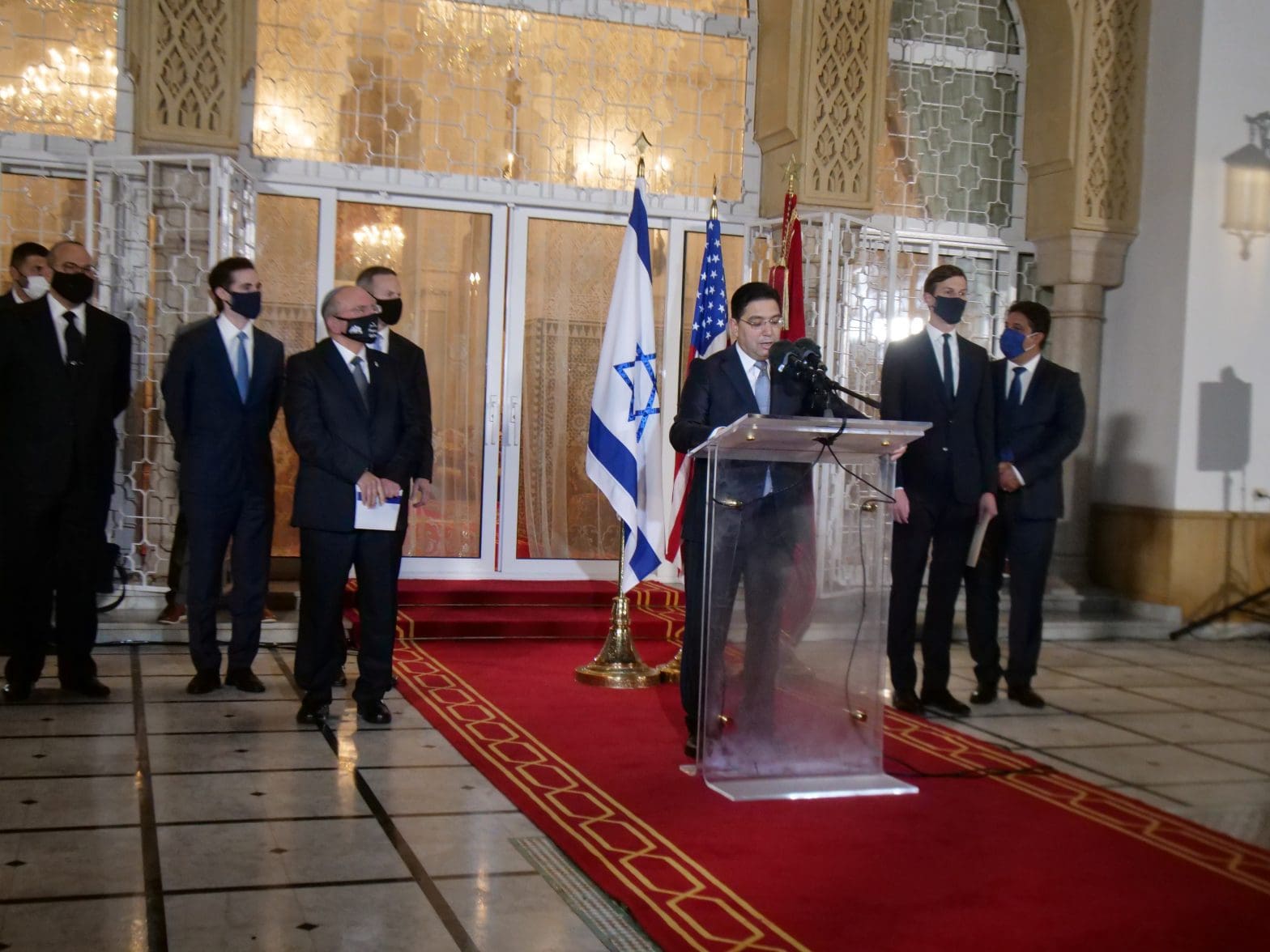
Beyond its symbolic significance, the Moroccan state’s historic deal with Israel and the United States has significant security, financial, and diplomatic implications. In exchange for partial — not full — normalization, the United States recognized Morocco’s sovereignty over Western Sahara, pledged $3 billion in investment to its private sector, and agreed to a $1 billion arms sale (pending approval by Congress). Partial normalization could also ensure major benefits from Israel in terms of trade, investment, and cooperation in key sectors such as tourism and technology.
Despite some domestic discontent and regional criticism, there will likely be further rapprochement between Morocco and Israel. Indeed, the Moroccan foreign minister expressed the kingdom’s intention to take the relationship as far as possible; and Israel’s foreign minister recently announced that he would visit Rabat in mid-August. The two states signed a cyberdefense accord in July 2021, and are likely to increase security and economic cooperation down the line. As long as the Biden administration does not reverse its predecessor’s recognition, Rabat so far has no reason to pull out of the deal. However, it remains unlikely that Morocco would go so far as to open an embassy in Israel due to domestic and regional opinion.
INVESTING IN AFRICA
Since 2016, Morocco has intensified its economic and diplomatic presence in sub-Saharan Africa. Moroccan companies increased cooperation with their sub-Saharan counterparts in various sectors, most notably in telecommunications, insurance, banking, and manufacturing. In fact, over a period of ten years (2008–2018), Moroccan-African trade rose by 68%; and in 2018, 85% of the kingdom’s foreign direct investment went to sub-Saharan states. In 2017, the kingdom rejoined the African Union over three decades after it withdrew its membership in protest over Western Sahara’s admission as an independent member state.
Morocco’s involvement in the region will not only boost its economy and diversify its alliance base but will also make it the West and China’s gateway to Africa — thereby opening the door for triangular trade deals and cooperation. In fact, economic cooperation with sub-Saharan Africa is closely tied to Rabat’s move to form closer ties with China over the last five years. The same year Morocco rejoined the African Union, the Bank of China opened its first branch in Morocco, while Morocco’s Bank of Africa opened a branch in Shanghai. Moroccan decisionmakers aim to turn Casablanca into a major financial center on the continent, and Chinese financial institutions seek to manage their activity in African markets from there.
Due to Morocco’s proximity to Europe, China also seeks to establish factories in the kingdom to manufacture goods that can be exported to Europe. In addition, Chinese construction companies have been involved in Tanger Med — a $10 billion industrial port complex being built in northern Morocco and the largest port in Africa. Morocco’s relationship with China has been successful in great part because China has not sought to intervene in the kingdom’s domestic affairs, unlike Europe.